Roomful Games › Family night games
Family night games with phones and a TV
The phones are already in the room, so let them be the game controllers. Put a game on the TV, everyone joins with a code, and the youngest and the oldest play the same game. Here's how to plan a night that works for everyone.
A plan for the night
- Warm up with the dailies. Do today's puzzles together while everyone arrives: Trivia 5, Guess the Number, Country Shape, Groups, Word Ladder, Letter Grid or Mystery Clue.
- Trivia for the whole room. Roomful Trivia with easy questions and a slow timer, so kids can read along. Pair a young child with a grown-up as a team.
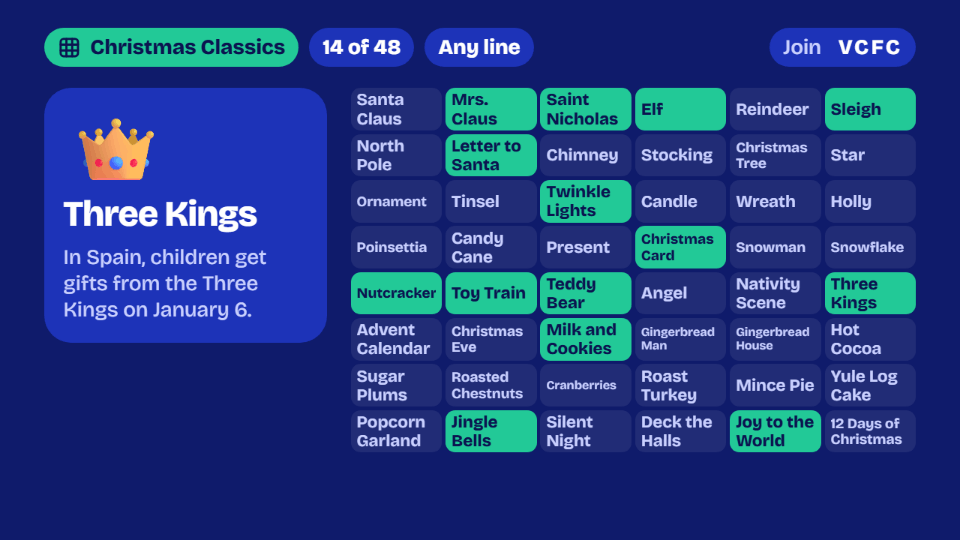
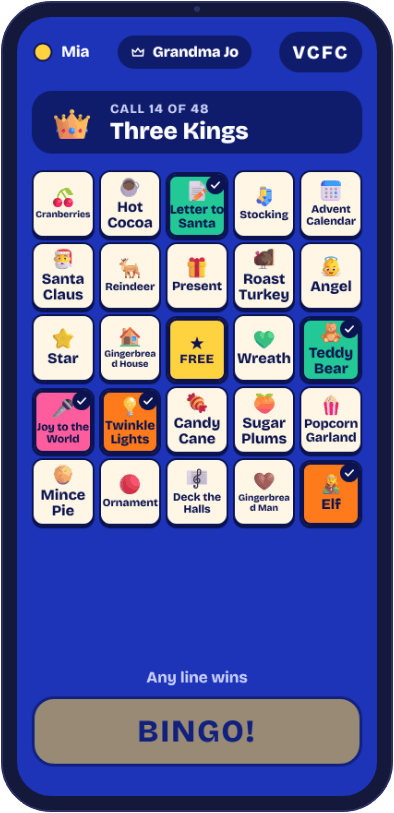
- Bingo with the snacks. Roomful Bingo calls the squares on the TV, and every phone gets its own card. Young children can let the game mark their card.
- Get up and act. Charades shows the word only on the actor's phone, and the TV keeps the time and the score.
- Wind down with cards. Crazy 8s or Go Fish on everyone's phones, with computer players filling empty seats.
Why bingo goes in the middle
If you only play one thing, make it bingo. Everyone gets their own card, nobody has to read quickly, and being six years old is no disadvantage at all. Each set has 48 squares on one theme and every card shows 24 of them around a free star, so no two cards are alike. The TV calls a square every 8, 12 or 20 seconds, or you can tap Next yourself, and it can read each call aloud.
A game to any line takes about ten minutes, four corners is quicker, and a blackout is a longer game to save for the end. Foods We Love is a good first set for a table of mixed ages, Animal Bingo and Ocean Bingo please the youngest, and Retro Bingo gets grandparents explaining things to grandchildren. Classic number bingo runs from B-1 to O-75, the way it's played in bingo halls.
Three different families, three different choices
- Four of you, kids 6 and 9. There's no need for a big plan. Picture bingo for ten minutes, then Go Fish with a computer player or two at the easy level.
- Six cousins aged 7 to 14, and two grown-ups. Trivia in mixed-age teams, then family charades. Everyone guesses, and the actor scores when someone gets it, so the small ones earn points too.
- Teens and grandparents, ten people in all. Bingo with Retro Rewind, then a mystery party. From 8 players there is a full cast, and with more than 8 the extras join as detectives with clues of their own.
- Just two of you. Try Crazy 8s or Spades, which has a two-handed version, or take on an escape room together: Wake Up, Pumpernickel! for younger children and The Unfinished Map for ages 10 and up with an adult.
Make it work for every age
- Choose easy questions or words, and let teams mix ages.
- Keep each game short: ten trivia questions or one bingo card is plenty for young children.
- No phone for someone? Bingo and charades cards print in a minute.
- Children under 8 can share a phone with a grown-up. In a teams game of trivia, the whole team sees its pick and can talk it over before locking it in.
Something bigger
For a special night, host a mystery party: everyone plays a character, and the room works out who did it. Or try the 20-minute escape room, where every phone holds different clues.
Friday at 6:30, a 90-minute example
Here's how an evening could go for a family of five with children aged 6, 9 and 12. Timings are generous, because someone will need a drink of water.
| Time | Game | Notes |
|---|---|---|
| 6:30 | Set up, and one daily puzzle | Get a laptop on the TV before dinner dishes are done. The 12-year-old can try Word Ladder while the others find a seat. |
| 6:40 | Roomful Trivia, 10 questions | Two teams on phones, Easier, Relaxed. About seven minutes of play. |
| 6:55 | Food Bingo, any line | Call every 12 seconds. The 6-year-old's card marks itself. Popcorn counts as research. |
| 7:10 | A blackout game | Same set, new cards. Longer, and everyone stays in it right to the end. |
| 7:25 | Charades | Kids Classic or Family Classic, 60 seconds a turn, two turns each. About 12 minutes with five people. |
| 7:40 | Crazy 8s | Five seats, all people. Young players can tap a hint if they get stuck. |
| 8:00 | Bedtime for someone | Anyone still up can play Solitaire or try Guess the Clues for one. |
The short list of things to get ready
- A TV or laptop everyone can see. Play on your TV has a two-minute video and the steps for four ways to connect.
- A phone or tablet for each player, or one for each pair. A browser is all it needs.
- Snacks that don't need two hands, since the phones need one of them.
- Do Not Disturb turned on for whichever device is showing on the TV, so messages don't pop up.
Small problems, quick fixes
- Grandpa's phone won't scan the QR code. Have him open the game's address in his browser and type the four letters instead. The TV shows both.
- The bingo call is silent. Reading each call aloud is off until you tick the box when you set up the game. Once it's on, a Test button lets you hear the voice on that TV.
- A teenager wanders in halfway through bingo. They can join with the code and get their own card, and the calls so far still count.
- A child's phone goes to sleep. Open the page again. The phone remembers its nickname and game, so it can rejoin after a refresh.
- The wifi drops out. Move the laptop near the router, use a cable, or switch phones to mobile data. For real emergencies, keep a set of printed bingo cards in a drawer.
Questions
- What do we need?
- A TV or laptop everyone can see and a phone for each player (or for each team). Play on your TV shows four ways to get a game on the TV.
- What ages can play?
- Everything is written for mixed ages. Bingo and charades work for children who don't read yet, and trivia has easy, medium and hard questions. The mysteries are for ages 8 and up, and the escape rooms each give their own age.
- Does it cost anything?
- No. Every game is free, with no app and no accounts.
- What if we only have one phone?
- Pass it around for charades, using the word picker, or choose Together on this screen in Roomful Trivia, where the room calls out answers and one person taps them in.