Roomful Games › Bingo › Ocean Life
Ocean Bingo
Ocean Life is a free bingo game of 48 squares from the sea: whales and dolphins, fish and sharks, crabs and sea stars, sea birds, kelp forests and coral reefs. Every square has a fun fact to share as you play.
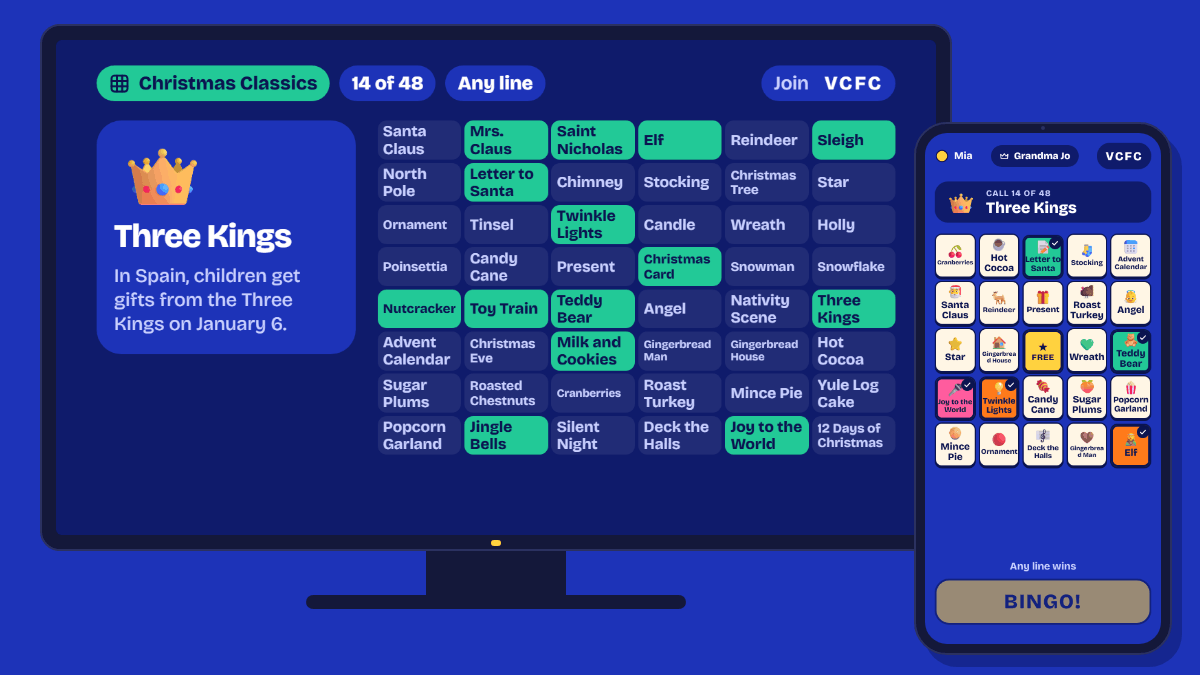
All 48 squares, with fun facts
- Blue WhaleBlue whales are among the loudest animals, and other whales may hear them up to 1,000 miles (1,600 kilometers) away.
- Humpback WhaleThe pattern on a humpback whale's tail works like a fingerprint, so scientists can tell whales apart.
- OrcaOrcas are actually the largest members of the dolphin family.
- DolphinEach bottlenose dolphin has its own special whistle that works a lot like a name.
- NarwhalA narwhal's long tusk is really a tooth, and it can grow up to about 10 feet (3 meters) long.
- Beluga WhaleBaby belugas are born dark, and their skin turns white as they grow up.
- ManateeManatees are nicknamed sea cows because they munch on seagrass and other water plants.
- Sea OtterSea otters have loose skin pockets under their front legs where they tuck food during a dive.
- WalrusWalruses use their long tusks to help pull themselves out of the water onto rocks or ice.
- Harbor SealHarbor seal pups can swim just minutes after they are born.
- Sea LionCalifornia sea lions bark like dogs to talk with each other.
- Whale SharkA whale shark's mouth can be up to 4 feet (1.2 meters) wide, but its teeth are tiny.
- Hammerhead SharkA hammerhead's wide-set eyes give it a better view than most other sharks have.
- ClownfishA clownfish dad guards his eggs and keeps fanning them to give them fresh oxygen.
- PufferfishPufferfish have four teeth that are fused together into a shape like a beak.
- SeahorseSeahorse dads carry the eggs in a pouch, and lined seahorse dads carry them for about 20 days.
- Manta RayA giant manta ray's fins can stretch up to 26 feet (8 meters) from tip to tip.
- StingrayA southern stingray can hide buried in sand with just its eyes and breathing holes peeking out.
- Flying FishFlying fish can leap out of the water and glide through the air for up to about 650 feet (200 meters).
- AnglerfishA deep-sea anglerfish has a fin like a fishing pole with a glowing tip full of tiny bacteria.
- Moray EelA moray eel opens and closes its mouth all the time because that is how it breathes.
- SwordfishSwordfish have a long, flat bill shaped like a sword and can swim up to 50 mph (80 km/h).
- OctopusA giant Pacific octopus can have up to 250 suckers on each arm, and it can taste with them.
- SquidA giant squid's eye can be up to 10 inches (25 centimeters) across, about the size of a dinner plate.
- JellyfishJellyfish have no brain or heart, and their bodies are about 95 percent water.
- Sea StarSea stars have no blood and use seawater to carry nutrients through their bodies instead.
- CrabFiddler crabs turn darker during the day and paler at night.
- LobsterMost live American lobsters are olive-green or greenish-brown, not red.
- ShrimpA snapping shrimp's claw makes a bubble that bursts with a loud snap.
- Hermit CrabHermit crabs sometimes line up from biggest to smallest to trade up to new shells.
- Sea UrchinA sea urchin's mouth is on its underside, with five toothlike plates around it.
- Sea AnemoneAt low tide, some sea anemones pull in and look like blobs covered in bits of gravel and shell.
- OysterUnder the right conditions, one oyster can filter up to 50 gallons (190 liters) of water in a day.
- Sand DollarA live sand dollar is covered in tiny spines that are gray to purple in color.
- Sea SlugOne sea slug, the lion's mane nudibranch, has a smell a bit like watermelon candy.
- Sea TurtleGreen sea turtles get their name from the green color of their fat, not their shells.
- PuffinWith its big, colorful bill, the Atlantic puffin is often called the clown of the sea.
- PelicanBrown pelicans keep their eggs warm by standing on them with the skin of their feet.
- AlbatrossA Laysan albatross named Wisdom has hatched more than 35 chicks over her long life.
- Coral ReefCoral reefs cover less than one percent of the ocean floor but support about 25 percent of sea creatures.
- Kelp ForestIn ideal conditions, kelp can grow up to 18 inches (46 centimeters) in just one day.
- SeagrassUnlike seaweeds, seagrasses have real roots, leaves, and even flowers and seeds.
- PlanktonThe word plankton comes from the Greek word for drifter or wanderer.
- Tide PoolAt low tide, you might spot sea stars, crabs, sea cucumbers, and even fish in tide pools.
- Deep SeaScientists say 80 percent of the animals living 650 to 3,300 feet (200 to 1,000 meters) deep can make their own light.
- Ocean CurrentThe Gulf Stream, a warm ocean current, carries more water than all the world's rivers combined.
- SeashellMollusks build their own shells as they grow, and snails like whelks grow theirs in a spiral.
- Ocean WavesWith nothing in their way, waves made by wind can travel across a whole ocean.
Playing Ocean Bingo with a class
The set runs from the sea's biggest animals (the Blue Whale and the Whale Shark) to its smallest (Plankton), and from the beach to the dark: Tide Pool, Kelp Forest, Coral Reef and Deep Sea are squares of their own, as well as the animals that live there.
Ask the class to sort each call as it comes: does it breathe air, like the dolphin, the sea otter and the sea turtle, or does it breathe water, like the clownfish and the octopus? Keep two columns on the board and see which is longer at the end.
The Anglerfish, the Narwhal and the Sea Slug are the calls that get the biggest reaction. Read their facts slowly.
How to play
Print up to 30 different cards with a caller sheet, or call this set on a TV while everyone plays on their own phone, or mix the two. How Roomful Bingo works, step by step, with the ways to win.
Print the cards
Cards print two to a US Letter page, each with its own card number in the corner, plus a one-page caller sheet that lists the squares in a random calling order. Everything is made in your browser: nothing to sign up for, nothing sent anywhere.